


Molecular evolution is echoed in bat ears
Related images
(click to enlarge)
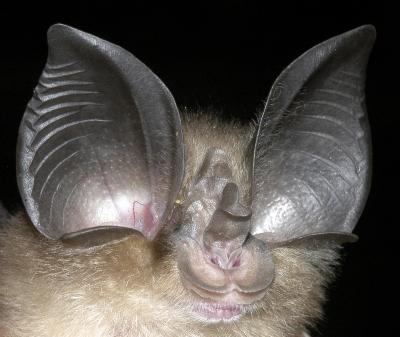
Echolocation may have evolved more than once in bats, according to new research from the University of Bristol published this week in Proceedings of the National Academy of Sciences (PNAS). Professor Gareth Jones of the University of Bristol and Dr Stephen Rossiter of Queen Mary University of London, in collaboration with colleagues from East China Normal University in Shanghai, investigated the evolution of a gene called Prestin in echolocating bats – mammals with the most sensitive hearing at high frequencies.
Prestin codes for a protein of the outer hair cells – the tiny structures in the inner ear that help to give mammals their sensitive hearing. Important mutations occurred during the emergence of mammals that led to the evolution of Prestin from similar proteins. Since mammals evolved, it has been argued that the Prestin gene has changed little.
The researchers studied the Prestin DNA sequence in a range of echolocating bats and fruit bats, which do not echolocate. They found that parts of the gene appear to have evolved to be similar in the distantly related echolocating species. Furthermore, they could not find any evidence of genetic changes in the Prestin of fruit bats that might be expected from a loss of high frequency hearing.
If Prestin does indeed help bats to hear their high-pitched echoes, then these results appear to support the idea that echolocation has evolved more than once in bats. This apparent independent evolution of a trait in distant relatives is known as convergence, a term that is more commonly used to describe the physical features of species that live in similar habitats and face similar selection pressures, such as the spines of hedgehogs and porcupines. Examples of convergence at a molecular level are very rare.
Professor Jones and Dr Rossiter said: "If hearing were an Olympic event, echolocating bats would be strong medal contenders. Their ears are tuned to higher sound frequencies than those of any other mammals because they need to listen to the returning echoes of their ultra-sonic calls.
"In recent years, scientists have discovered the curious fact that echolocating bats do not all group together in the evolutionary tree of life, but instead, some are more related to their non-echolocating cousins, the fruit bats. This has raised the question of whether echolocation in bats has evolved more than once, or whether the fruit bats lost their ability to echolocate.
"Evolutionary biologists have long appreciated that morphological similarities may not reflect evolutionary affinities among animals because of convergent evolution – similar lifestyles can cause distantly related animals to resemble one another when they occupy similar environments because natural selection will favour similar outcomes.
"Now the same seems to be true for gene sequences – the need to echolocate can cause genes to converge in their structure. Our study suggests that scientists should be cautious when inferring evolutionary relationships from genes that may be involved in important functions and, therefore, could be shaped by convergent evolution ."
Source: University of Bristol
Articles on the same topic
- Molecular evolution is echoed in bat earsFri, 5 Sep 2008, 14:08:49 UTC
Other sources
- Molecular evolution is echoed in bat earsfrom Science BlogFri, 5 Sep 2008, 15:14:09 UTC
- Molecular evolution is echoed in bat earsfrom Biology News NetFri, 5 Sep 2008, 15:07:41 UTC
- Molecular evolution is echoed in bat earsfrom Biology News NetThu, 4 Sep 2008, 18:49:37 UTC
- Molecular Evolution Is Echoed In Bat Earsfrom Science DailyThu, 4 Sep 2008, 15:28:18 UTC
- Molecular evolution is echoed in bat earsfrom PhysorgThu, 4 Sep 2008, 15:21:35 UTC